Platform · AI · 2026
KlindrOS — three products on one marketing engine
One data pipeline and one 0–100 scoring framework power three products: Core for brand teams, KScore Business as the sales front door, and KScore Personal as a three-minute personal-brand audit.
People ask me what KlindrOS actually does in daily work, not in a feature list. So I wrote the real scenarios. KlindrOS ships as three products on one shared engine — Core for brand teams, KScore Business as a single-account sales scan, and KScore Personal as a three-minute personal-brand grade. All three read from the same pipeline and the same 0–100 scoring framework, called KEI.
Part 1 · KlindrOS Core
Brand managers, heads of growth, and agency partners log in to Core. They connect Instagram, TikTok, LinkedIn, YouTube, Facebook, and X, plus Meta Ads, Google Ads, TikTok Ads, LinkedIn Ads, and GA4. Core unifies all of it into one screen with KEI scores, ROI attribution, autonomous optimization, and AI-written insights. Think Bloomberg Terminal for marketing: high data density, sharp answers.
An agency runs six clients from one screen
You run a growth agency with six D2C clients, each in a different set of tools. Reporting eats two days of your week. You connect each client as a separate tenant in Core, isolated by an org_id so no client ever sees another’s data. Each account syncs through a native connector, not a CSV re-export. You open one client and see the KEI score, top posts, channel ROI, and AI alerts in under a second, because Core serves cached daily aggregates instead of hitting each platform live.
Your Monday reporting drops from two days to two hours. You spot that Client A wastes budget on last-click, and Client B has a rising fatigue signal on Reels — and you act on both the same morning.
A growth lead fixes wasted ad spend
You spend Rp 200 million a month across Meta and Google. Your reports credit the last click, so paid search always looks like the hero and social always looks weak. You open ROI Attribution and switch from last-touch to a data-driven model. Core rebuilds the credit across every touchpoint — and you see that Instagram and TikTok start most of the journeys that paid search closes. Social was doing the first job. Last click hid it.
You move budget with Media Plan Creation, set Budget Guardrails so no channel drops below a floor or blows past a ceiling, and turn on Autonomous Optimization, which flags weak line items and proposes shifts. The emergency-stop button stays in reach the whole time. Your blended cost per acquisition falls because you paid for the work that actually drove sales.
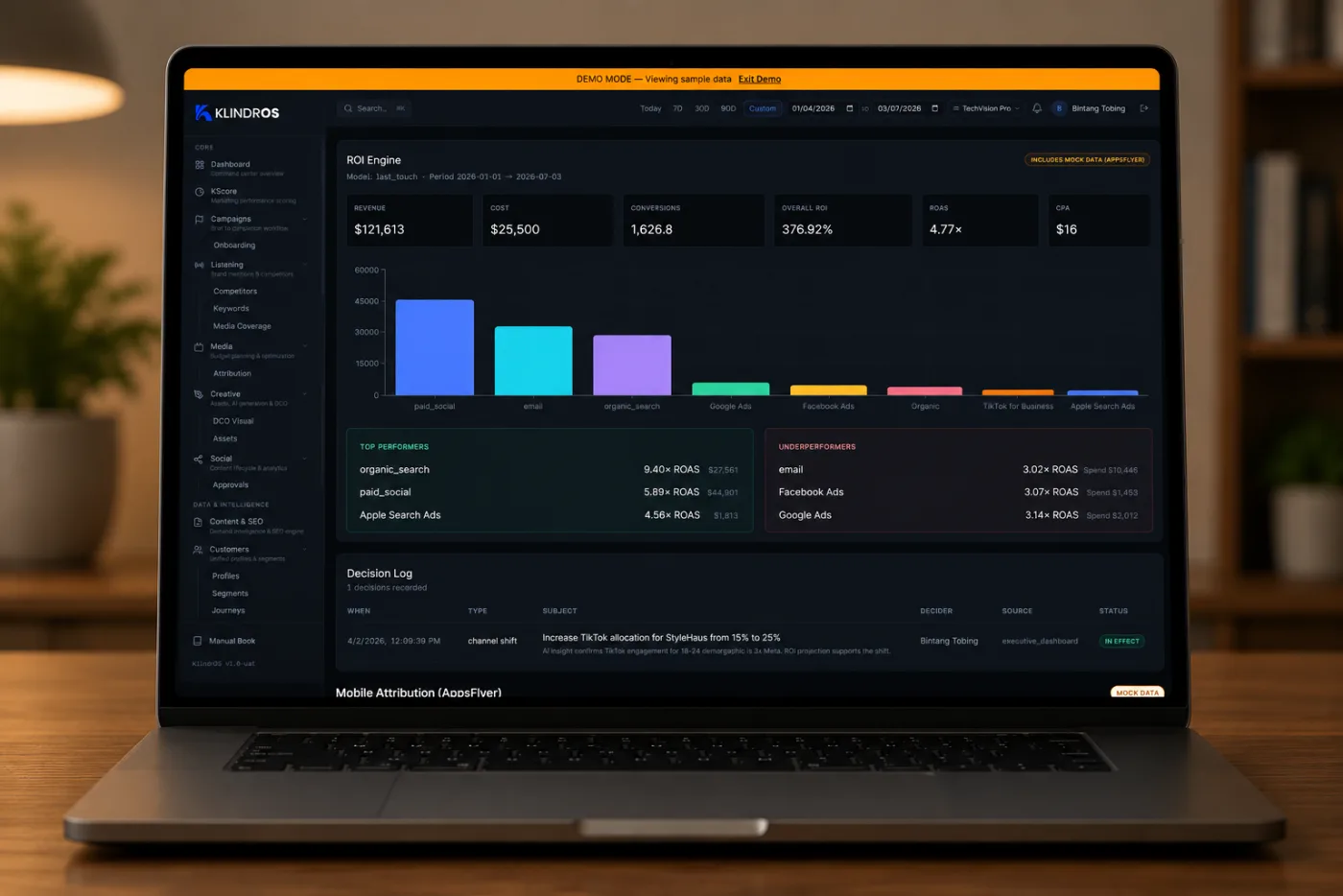
A brand catches creative fatigue early
Your Reels used to pull strong engagement; lately the numbers slide. Core watches this with the Organic Fatigue Index — it tracks the slope of your engagement over time, and when the slope turns down it flags fatigue and triggers the Creative Auto Pipeline. That pipeline generates fresh variants, runs an A/B test with a real significance check, and keeps the winner. No person sits in the critical path, so you replace tired creative before the drop hits revenue.
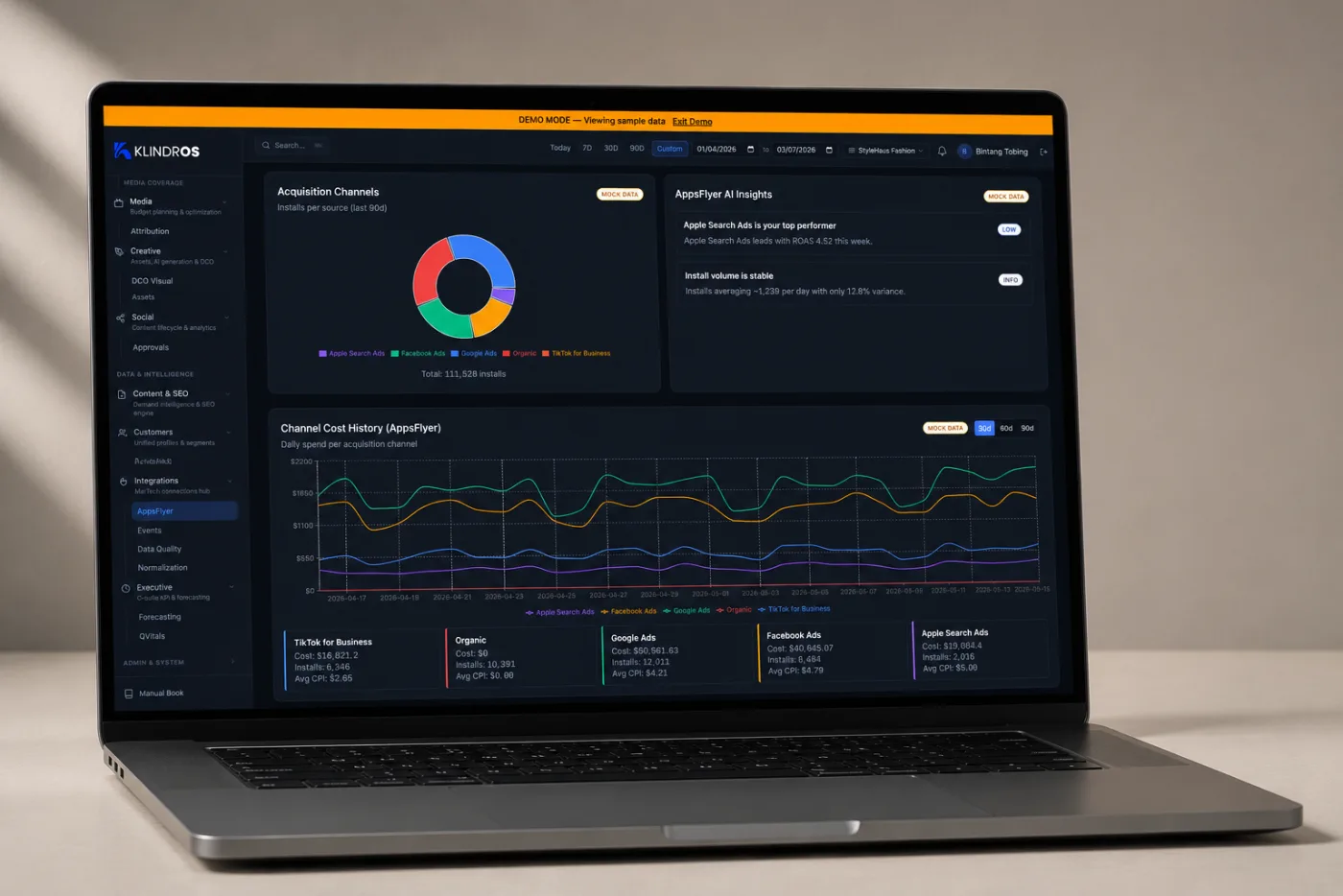
A CMO skips the Friday deck
Every Friday your team burns four hours building a board deck. Core sends a weekly stakeholder email on a schedule you set per tenant — trend summary, anomalies, action items, with a PDF and CSV attached. The Executive Dashboard adds forecasting and scenario planning: preview what happens to revenue if you shift budget or refresh creative, and compare the current plan against the proposed one with a confidence interval. The four-hour deck becomes a five-minute review.
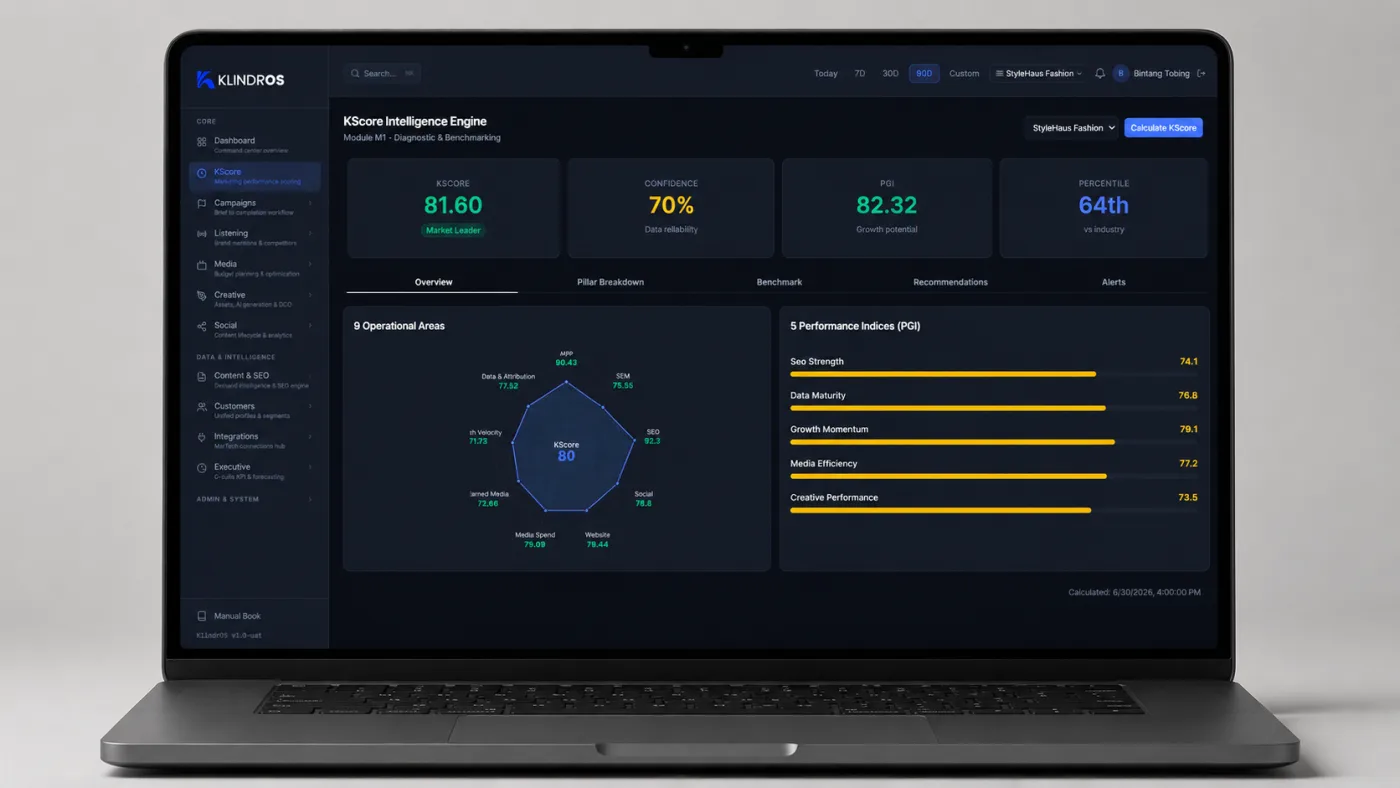
What makes Core different: every number traces back to a real scan or event. KlindrOS does not sell customer data or train public AI models on tenant data. The KEI score is not a naive average — it weights each platform and corrects for the denominator effect, because 100,000 followers on Instagram do not equal 100,000 on LinkedIn.
Part 2 · KScore Business
KScore Business is the single-account scan for companies — the front door to Core. It scans one brand account on one platform and returns a report framed for a decision-maker, in about two minutes. You sell marketing services; cold outreach gets ignored because it offers no value up front. So you run KScore Business on the prospect’s Instagram and reach out with the report, not a pitch: here is where your brand stands, and here is the one gap that costs you reach. The message leads with the prospect’s own data, and your reply rate climbs because you opened with proof instead of a promise.
You turn a pitch into a diagnosis. The prospect sees the gap and the path to close it in one session.
The scan is free, because its job is to start the relationship, not to earn a fee. Personal Scan sends a person toward a self-service upgrade; Business Scan sends a company toward a sales call. Same engine, different door.
Part 3 · KScore Personal
KScore Personal is the consumer scan — it grades your personal brand across six platforms (Instagram, TikTok, LinkedIn, YouTube, Facebook, X) in three minutes, with a score per platform, an AI analysis naming your three strongest growth moves, and a PDF report. You pick a persona when you start — Brand, Career, or Creator — and the persona shapes the analysis and the AI chat.
A job seeker runs the Career persona: the scan grades their LinkedIn against the other platforms, and the paid tier adds an optimal posting schedule as a day-by-hour matrix, a content mix, and three evidence-backed growth moves. A creator runs the Creator persona to find out why growth stalled — the scan reads the last ninety days and returns an audience-quality read and a consistency audit, then Klaira, the AI strategist, explains why the score sits where it sits. Klaira talks strategy; she does not write your captions.
Honest unit economics
I include this so you see the model is real, not smoke. A baseline Personal scan costs KlindrOS about eight US cents — six scrapers around four cents together, the AI analysis about four cents, with YouTube data and IP geolocation on free tiers. A full Klaira chat at the fourteen-turn ceiling pushes the worst case to about thirty-four cents. Every cost gets logged per event in a vendor-cost dashboard, so the unit economics stay visible.
How the three work together
- 3 products on one shared engine
- 6 social platforms scored
- ~2 min a full account scan
- ~$0.08 cost to run a personal scan
The three products form one funnel. KScore Personal reaches an individual and builds awareness. KScore Business reaches a company and captures a lead. KlindrOS Core serves the brand team that signs on. You can enter at any door — a creator who scans a personal brand today may run an agency tomorrow that lives in Core — because one engine feeds all three.
Lead with the customer’s own data. Trust the attribution, not the last click. Measure before you act. And keep the economics honest — you can price and scale on numbers you can see.